Technology
Optics for existing screens
RealSpace is a passive optical viewing system for conventional displays. It is designed to modify the apparent viewing geometry of a flat screen, allowing the user to experience the image with reduced near-screen visual demand while preserving the original content and display pipeline.
The problem
Flat screens ask the visual system to do something unnatural for long periods: maintain sustained near focus while interpreting images that often contain strong cues to depth and distance. Over time, this can contribute to visual fatigue, dry-eye symptoms, headaches and reduced comfort.
In many professional settings, the issue is not that the display lacks resolution. It is that the user's eyes must work continuously at a fixed near distance to access that information.
Accommodation and vergence
Two linked systems shape comfortable vision.
Accommodation is the focusing response of the eye. Vergence is the inward or outward alignment of both eyes toward a target.
On a conventional screen, both systems are held at a near working distance for long periods. RealSpace is designed to shift that optical demand toward a more relaxed viewing state, while the physical screen remains exactly where it is.
What the optic does
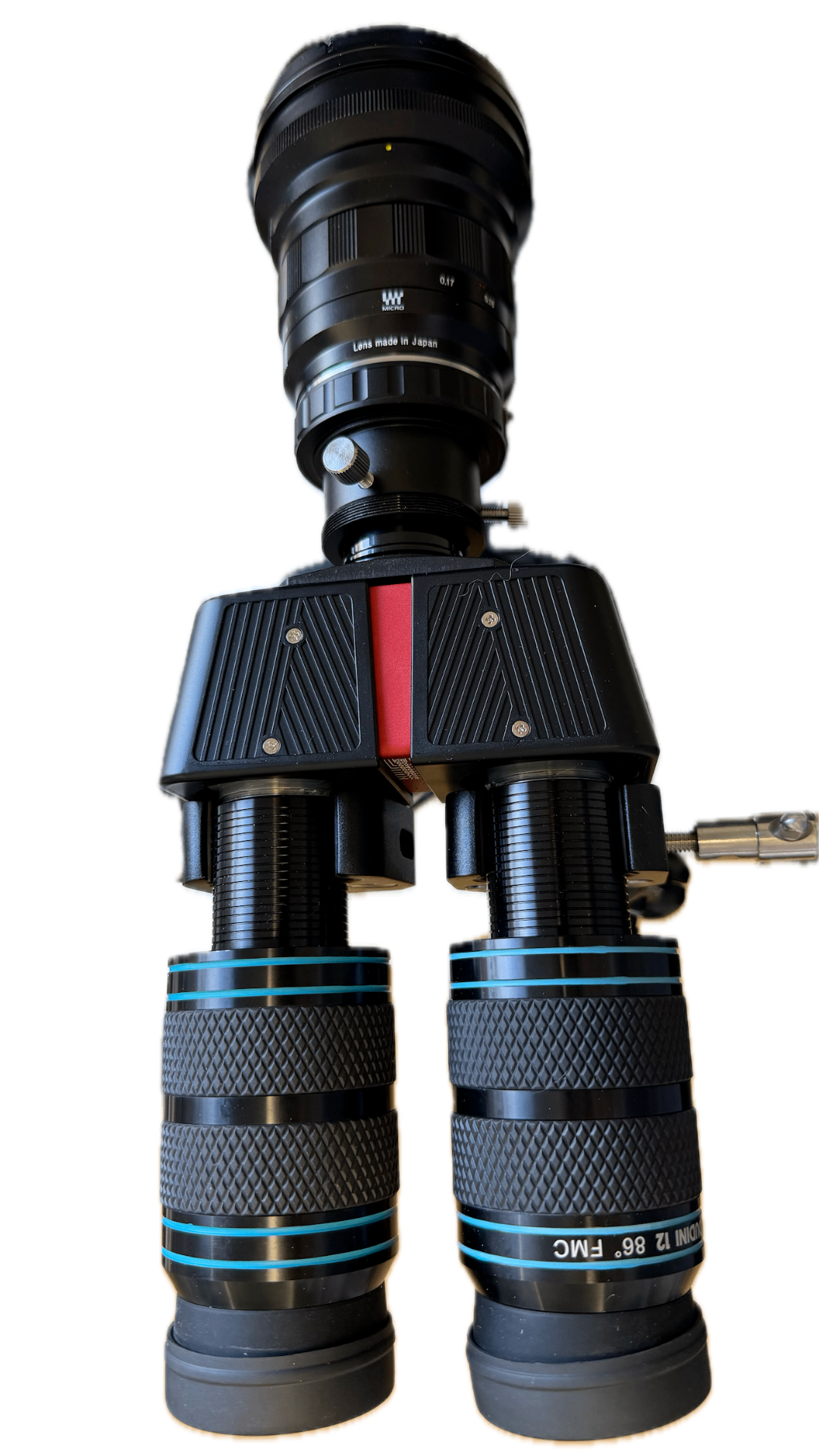
The RealSpace optic presents a conventional display through a precision refractive system. The current prototype architecture uses multi-element apochromatic optics and freeform correction to control magnification, distortion, chromatic error and field behaviour.
The intended result is simple: the screen remains a normal screen, but the visual system receives a more comfortable optical presentation.
What it does not do
- RealSpace does not create artificial stereo images.
- It does not modify medical images, video frames or source content.
- It does not require rendering, tracking, cameras or passthrough.
- It does not place the user inside a virtual environment.
Engineering status
RealSpace has progressed from large optical demonstrators to compact multi-element prototype designs. The current development focus is production engineering: manufacturable optics, repeatable alignment, user fit, hygiene, field clarity and validation in screen-intensive professional environments.